
A radio network of your own, not a subscription per lamp.
Adaptive lighting needs to talk to every luminaire in real time, for decades, without a bill attached to each one. That requirement is what made us build our own mesh instead of renting somebody's network.
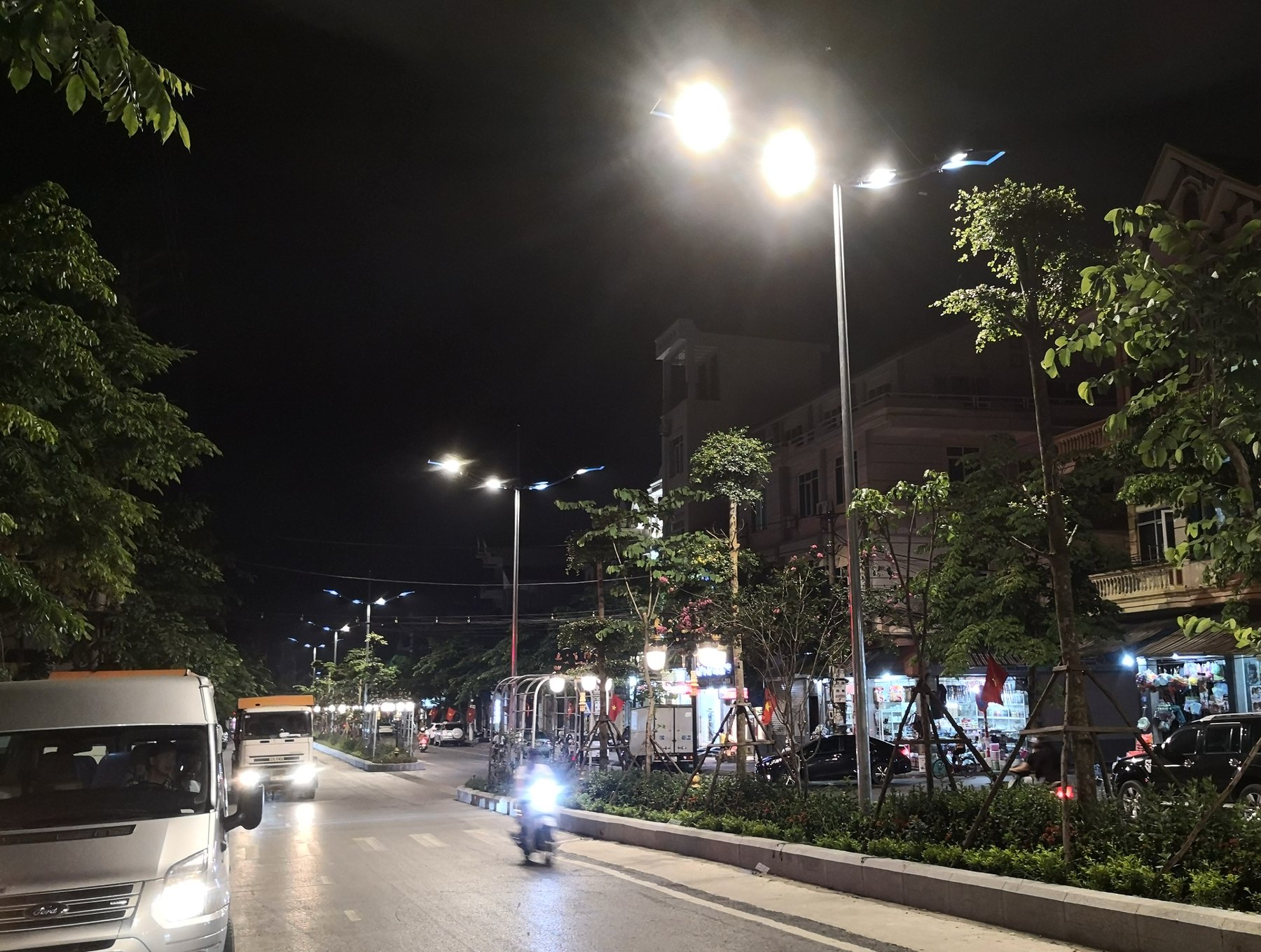
Main road at night — luminaires on the mesh, installed site
Every device is a node and a repeater.
Luminaires pass messages to each other until they reach a gateway. Add a pole and you extend the network; lose one and the traffic goes around it.
A licence-free band and a standard designed for dense, low-power mesh networks.
Each gateway serves a cluster; a city is a set of clusters, not one fragile network.
The network reaches well beyond the gateway, along the road rather than in a circle.
Every frame authenticated and encrypted, with keys held per installation.
From the pole to the platform, in three steps.
Roughly six gateways carry a thousand luminaires. The rest of the network costs nothing to run.
Sits on the luminaire, drives the driver over DALI-2 / D4i or 0–10 V, measures its own energy, and keeps its schedule in local memory.
Collects a cluster and carries it out over Ethernet or LTE. One SIM per cluster instead of one per luminaire.
Hosted in your country or on your own servers, with the map, the history, the alarms and the export.
Why not LoRaWAN, NB-IoT or PLC.
All of them control lighting in some way. The question is whether they can carry an adaptive system — a level per luminaire, changed in real time — and what they cost per device over the life of the plant.
| iLCS mesh | PLC | NB-IoT / LTE-M | LoRaWAN | Sigfox | |
|---|---|---|---|---|---|
| Message rate per device | Real time — at least once a minute | Low, shared | Frequent, metered | A few per hour | A few per day |
| Recurring cost per device | None | None | SIM per device | Per network / per device | Per device |
| Works if the internet drops | Yes, decisions stay local | Partly | No | No | No |
| Network owned by | You | You | An operator | You or an operator | An operator |
| Depends on the cable | No | Yes, and on its quality | No | No | No |
| Good for | Adaptive and control at scale | Existing plants with clean lines | Isolated devices | Battery sensors | Rare alarms |
Networks built for battery-powered meters are excellent at what they were designed for. We use LoRaWAN ourselves for third-party sensors. But a lighting class that changes with traffic needs a conversation, not a daily postcard.
No radio survey. No propagation study. Send the pole map.
Coverage is where most wireless lighting projects lose weeks — and sometimes the budget — before a single device is fitted. With this mesh it is simply not the variable. Across the installations we have delivered, in dense city streets and on long rural roads alike, we have not had to redesign a network because the radio would not reach.
Power in reserve, used only when a hop needs it
The nodes have output power to spare within the limits of the band, and they use it where a span is long or awkward. Most of the time they do not need to: the network is made of many short hops, which is also what keeps the emission of each device low.
Every node is a repeater, and the route is not fixed
Messages find their way around a bend, a tree canopy or a failed device by taking another path. A network with hundreds of possible routes does not depend on any one of them being clear — which is what a point-to-point link cannot offer.
We ship, you fit, it works
No site survey campaign to pay for, no propagation study to commission, no weeks of waiting before the order can be placed. The devices are shipped and the installation team fits them.
One afternoon on a map, and it is planned.
All we need from you is the list of luminaires — coordinates, or a map with the stretches marked — and where your feeder pillars are. Everything else is our side of the work.
Groups of about 100 to 150 luminaires, following the shape of the roads rather than an abstract grid.
The gateway needs mains power 24 hours a day and somewhere to sit, so it usually goes in one of your feeder pillars or technical cabinets — supplied by you. That is the only reason for choosing that spot: no new supply, no new cabinet, no mast.
The luminaires a gateway carries have nothing to do with the circuit that feeds them: one cluster normally spans several feeder pillars, and the two maps do not have to agree. The mesh is independent of the power distribution.
A position per cluster, indicated on your map, with the backhaul it will use — the line already in the cabinet, or LTE.
Coverage inside the cluster is not something you have to design, budget for or verify in advance. It is the part we take responsibility for.

Our burn-in room — nodes powered continuously, with the mesh running between them
The network runs for years in our own room before it runs on your street.
A wall of nodes in our building, powered 24 hours a day and never switched off — for years, not for a test week — with the mesh working between them the whole time.
Joining, routing, recovery and updates are exercised continuously on a real network of devices, not only in simulation.
Street lighting hardware is expected to last a long time in the field. The only honest way to find what fails after thousands of hours is to leave the devices lit and wait.
Send us the pole layout.
A list of coordinates, or even a map with the stretches marked, is enough for us to come back with the number of gateways and where they should go.